Advanced Somatic Cell Detection Technology

SomaticScan device

Detect mastitis early, optimize milk quality, and protect your herd’s wellbeing with cutting-edge diagnostic technology.
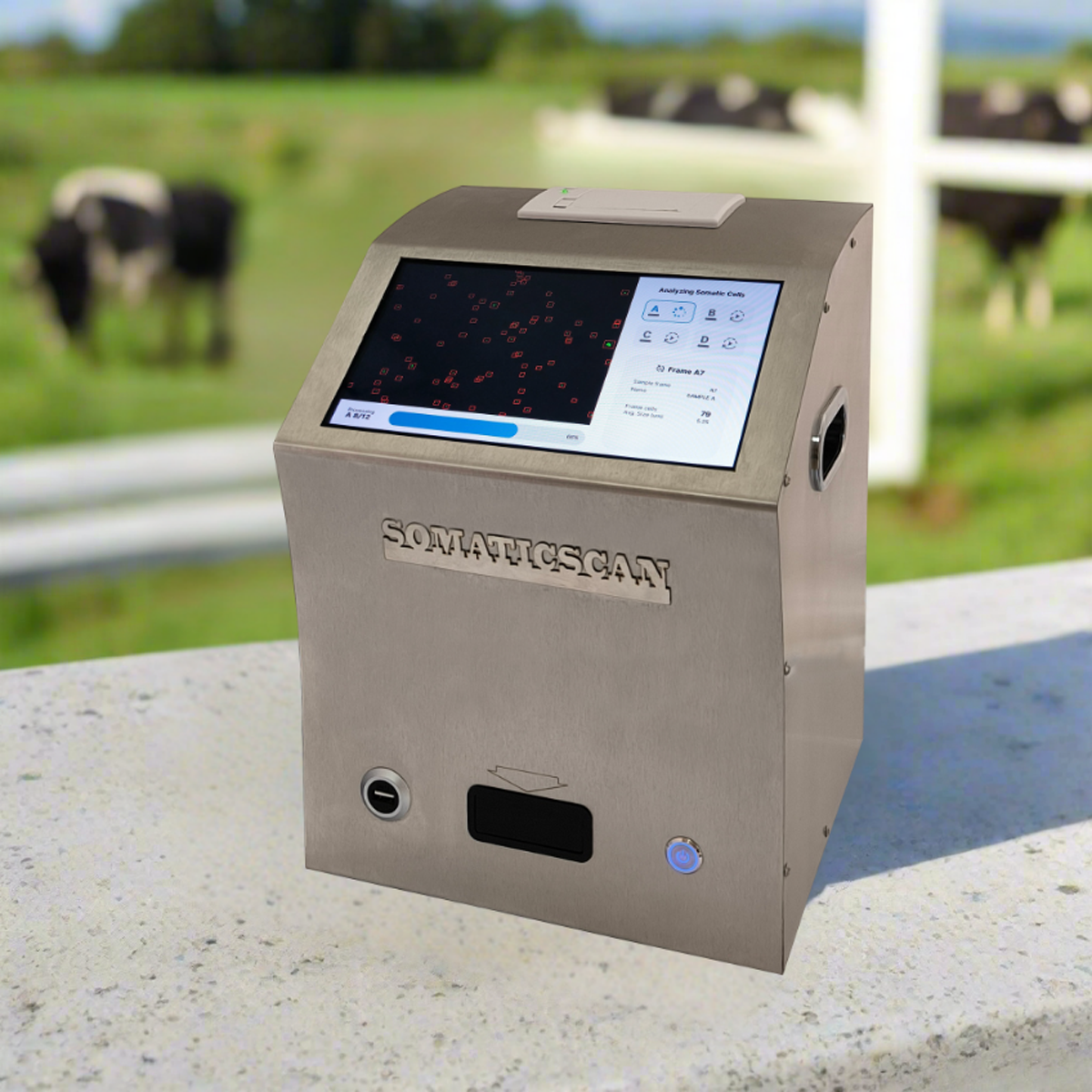
An automated somatic cell counter machine, labeled 'SOMATICSCAN', placed on a concrete surface with a field of cows in the background.

Somatic Cell Counter

SomaticScan is a new generation counter that includes a new advanced form of the somatic cell count test, giving a more detailed picture of the actual inflammatory status of the mammary gland.Somatic cells are  appear in large numbers to eliminate infections and repair tissue damage done by bacteria. Counting the cells thereby helps to indicate the presence of Mastitis in dairy cattle.

Buy Now

Somatic Cell Counter + Milk Analyzer

The SomaticScan Combo is a next-generation counter with an integrated milk analyzer that includes a new, advanced form of the somatic cell count test, giving a more detailed picture of the actual inflammatory status of the mammary gland.

Buy Now

How to Prepare Milk Samples for Analysis

SomaticScan starter KIT 100

The Starter KIT is included with the purchase of the Somatic Cell Counter and contains supplies for 100 tests .

Buy Now

SomaticScan KIT 200

Somaticscan KIT 200 contains supplies needed to make 200 tests

Buy Now

SomaticScan KIT 400

Somaticscan KIT 400 contains supplies needed to make 400 tests

Buy Now
  • Fast and Accurate Testing

    Real-time somatic cell counting for raw cow and buffalo milk

  • Automatic Precision

    Fully automated counting and eliminates human error

  • Cost-Effective

    Low cost per test and high productivity

  • Easy to Use

    No training required for operation

Direct measurement versus indirect estimation

Why is SomaticScan positioned in a higher price range than a viscometric analyzer?

Read more

Detect subclinical and clinical mastitis

Read more

How the Automated SCC SomaticScan Somatic Cell Counter HelpsMonitor Cow Health and Detect Mastitis Early

Read more
Economic Benefits for Farmers from Determining theTotal Somatic Cell Count in Raw Milk

Read more

Built with advanced direct fluorescent microscope

Removes the uncertainty and bias found in conventional microscopic techniques

  • What do somatic cells in milk indicate?

    Somatic cells in milk are an important indicator of
    the health status of the mammary gland. The somatic cell count (SCC) represents
    the total number of white blood cells and epithelial cells from the mammary
    gland contained in one milliliter of milk. These cells play a key role in the
    defense mechanisms of the udder by participating in the phagocytosis of
    pathogenic microorganisms and in the processes of repair of damaged tissues.
  • Does all milk have somatic cells?

    Yes, somatic cells are present in the milk of all dairy cows. In healthy
    animals, their number is usually low and considered normal. However, when cows
    suffer from mammary gland diseases, most commonly mastitis, the number of
    somatic cells increases significantly as a result of the inflammatory process.
  • What are normal somatic cell count levels in milk?

    The normal somatic cell count in milk typically ranges
    between 200,000 and 300,000 cells per milliliter. In the presence of an
    infection in the mammary gland caused by pathogenic bacteria, the number of
    white blood cells increases sharply, leading to an elevated somatic cell count
    (SCC). Values above 300,000 cells per milliliter are considered an indicator of
    increased risk of disease, most commonly mastitis.
  • What are the causes of increased somatic cell count in milk?

    A high number of somatic cells in milk is mainly caused by the penetration
    of infectious pathogenic bacteria and environmental pathogens into the cows’
    mammary gland. These microorganisms trigger an inflammatory response, during
    which the body increases the production of somatic cells as a protective
    mechanism. If cows suffering from mastitis are not promptly isolated and
    treated, there is a risk of cross-infection, leading to the spread of the
    disease and an increase in the number of affected animals.
  • What affects somatic cell count?

    The somatic cell count (SCC) in milk is influenced by several key factors,
    the most significant being mastitis. In addition, hygiene during milking, the
    level of stress in the animals, housing conditions, and the quality of
    nutrition play an important role. An elevated SCC is often a signal of udder
    infection, most commonly mastitis. Proper management of these factors helps
    maintain a low SCC, better milk quality, and good overall health in cows.
  • How is somatic cell count related to mastitis?

    There is a direct relationship between the number of somatic cells and mastitis.
    When mastitis occurs, the immune system activates the body’s defense mechanisms
    and sends an increased number of somatic cells into the milk to fight the
    infection. As a result, the somatic cell count (SCC) rises significantly.
    Values above 300,000 cells per milliliter are generally considered indicative
    of the presence of mastitis or a high risk of developing it.
  • Can the number of somatic cells in milk be reduced?

    Reducing the number of somatic cells in milk requires
    comprehensive and proper farm management. Key measures include improving
    hygiene and disease prevention on dairy farms, as well as maintaining
    cleanliness and good order in the barns. It is also important to strictly
    monitor feed hygiene and quality. Enhancing the cows’ immunity through balanced
    nutrition and good housing conditions helps reduce the risk of mastitis and,
    consequently, lowers the somatic cell count in milk.
  • What can we use to test the number of somatic cells in milk?

    The number of somatic cells in milk can be tested using a somatic cell
    counter such as the SomaticScan or SCC SomaticScan Combo. This device allows
    accurate counting and classification of the cells in a milk sample, providing
    an objective assessment of milk quality. Such equipment is widely used in the
    dairy industry, livestock management, and health monitoring of dairy animals.